
Rules for flying drones in Nepal
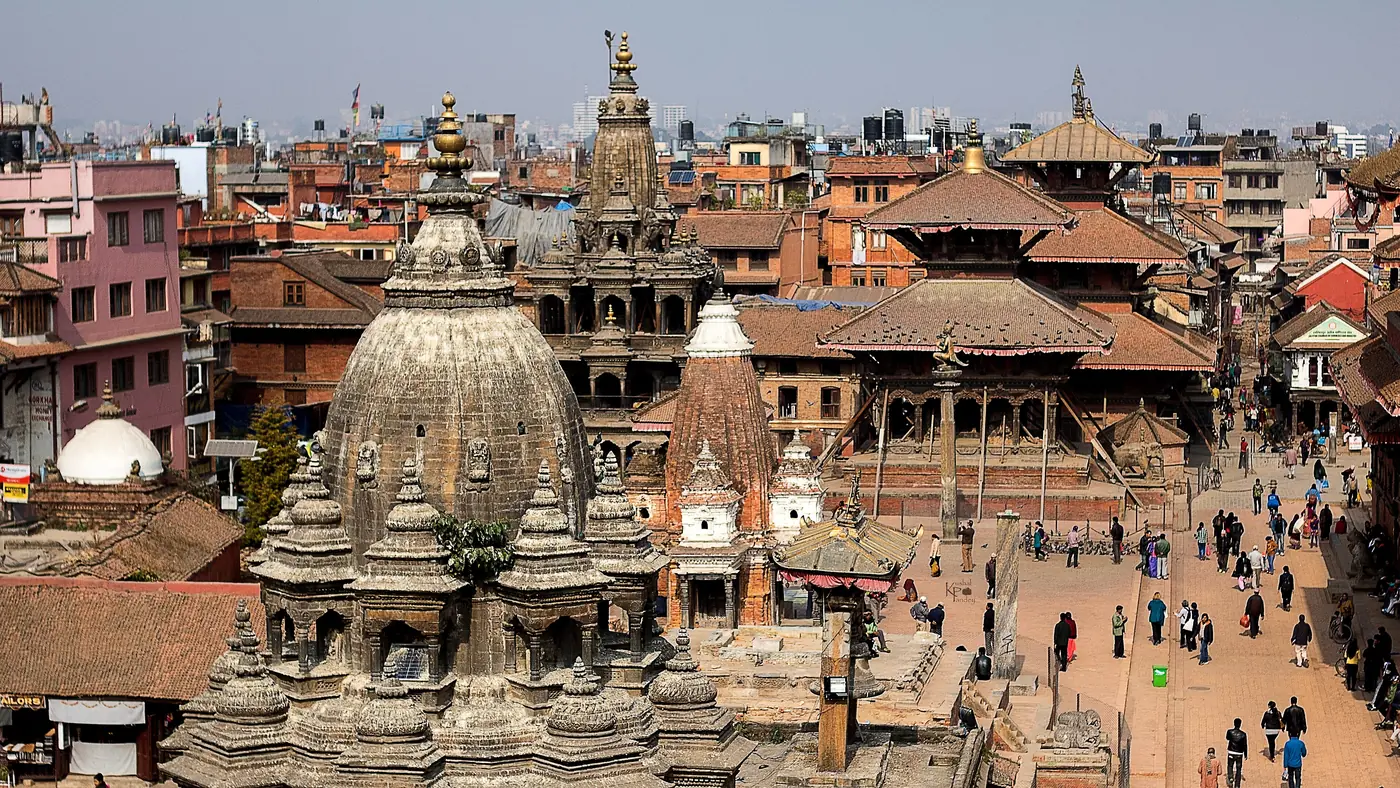
A plain-language summary of the Civil Aviation Regulations, CAAN's Unmanned Aircraft System Requirements and the Home Ministry's Drone Operation Procedure, 2019. Heritage sites such as Patan Durbar Square, shown here, are no-fly zones.

Registration
Every drone must be registeredUASR / RPA Form 001
All unmanned aircraft must be registered with CAAN and carry a Unique Identification Number (UIN) before any flight. Registration is valid for one year and must be renewed. Registration does NOT by itself authorize flight.
Weight categories
A: under 250 g · B: 250 g – 2 kg · C: 2 – 25 kg · D: over 25 kg (special CAAN authorization). Category is based on Maximum Take-Off Weight including battery, propeller guards and payload.
Documents requiredRPA Form 001 / 002
Registration form (RPA/Form/001), purpose-of-operation & commitment letter (RPA/Form/002), passport-size photo, citizenship / passport / company registration, manufacturer manual or spec sheet, photo showing the serial number, VAT invoice (bought in Nepal) or TIA customs clearance certificate (imported), and CE or equivalent conformity marking.
Category C and D drones
Drones over 2 kg require valid third-party liability insurance and must be presented at the CAAN Flight Safety Standards Department (FSSD), Sinamangal, for physical verification.
Display the UIN
Once issued, the UIN must be permanently and legibly marked on the aircraft.
Pilot licensing
Remote Pilot Licence (RPL)UASR 102.2
Required for commercial operations and category C/D drones. Applicant must be 18+, have Class 12 or equivalent, complete at least 10 hours of training at a CAAN-recognized organization, pass a written exam and practical flight test, and hold a valid medical certificate.
Licence validity and suspension
The RPL is valid for two years. CAAN may suspend or revoke a licence through a show-cause procedure.
Operating limits
Maximum altitudeUASR 101.7
100 m above ground level. Higher flights need CAAN authorization and a NOTAM (24 h notice). Note: some sources cite 120 m; the stricter figure applies until CAAN confirms.
Visual line of sightUASR 101.7
Keep the aircraft within unaided visual line of sight and within 300 m horizontally. BVLOS requires special authorization and ATS coordination.
Distance from people and structures
Keep at least 50 m from uninvolved people, vehicles, vessels and structures, and at least 150 m from congested areas or gatherings of more than 1,000 people. Never fly over crowds.
Daylight and weather
Daylight operations only, in visual meteorological conditions with visibility over 5 km.
One aircraft per pilot
A remote pilot may operate only one aircraft at a time.
Airspace & zones
Airports
No flying within 5 km of any airport or aerodrome movement area.
Borders and security sites
No flying within 5 km of the international border, 1000 m of army installations, or 500 m of security agency buildings. Singha Durbar, Maitighar Mandala and the residences of the President, Vice President and Prime Minister are no-fly zones.
Heritage and religious sites
Pashupatinath, Boudhanath, Swayambhunath, the Durbar Squares and other heritage sites are no-fly zones unless specifically authorized.
Temporary flight restrictions
TFRs are issued for VVIP movements, national events and disaster response. Check the live map and notices before every flight.
Permits & approvals
Flight permit required
A location-specific flight permit is required in addition to registration. Permits are valid for up to 90 days and may be extended once by 90 days with a valid reason.
Who approves what
CAAN issues the flight permit. Drones under 2 kg also need District Administration Office permission for the flight area. Drones over 2 kg, foreign nationals, commercial and survey/mapping missions require Ministry of Home Affairs security clearance (typically 5–15 working days).
National parks and conservation areas
Four steps: (1) NTNC approval letter (NPR 12,500 fee), (2) Chief District Officer approval, (3) DNPWC permit, (4) Conservation Area / Park Office permit. An escort must accompany all flights at the operator's cost. Everest also needs Sagarmatha NP and local municipality approval.
Safety & conduct
Give way to manned aircraftUASR 101.33
Drones must always yield to manned aircraft, including helicopters on rescue missions.
No alcohol or impairmentUASR 101.45
Do not operate within 8 hours of consuming alcohol or while impaired.
No dropping objectsUASR 101.19
Dropping articles or animals from a drone is prohibited unless specifically authorized.
Emergency operations
Do not fly over police, fire, rescue or military operations without written consent of the person in charge.
Incident reporting
Report any incident causing injury or third-party damage to CAAN within 48 hours.
Enforcement
Penalties
Violations may lead to on-the-spot seizure, fines (reported as NPR 2,000–5,000 for minor offences), arrest, prosecution and licence cancellation. Flying in restricted zones and privacy violations are treated as serious offences.
InspectionUASR 101.007
CAAN officers and security personnel may inspect any drone, registration, permit and pilot log at any time. Carry your UIN certificate and permit number when flying.
If this summary differs from the official CAAN directives or the Civil Aviation Regulations, the official documents apply.